 Guaria Montessori
Why the Four-Pillar Method Works
A deeper look at the science behind how we use the most important years of brain development.
The brain between 15 and 48 months
Between 15 and 48 months of age, a child's brain forms synaptic connections at a pace it will never match again — up to one million new neural connections per second. This is not gradual growth. It is a construction period: the brain is building the fundamental architecture of thought, language, emotion, and reasoning that will shape everything that comes after.
Neuroscience has shown that the quality of a child's experiences during this window directly determines which neural pathways strengthen and which are pruned away. Connections that are used grow stronger. Connections that are not used disappear. This is not a metaphor — it is the literal mechanism by which a child's brain takes shape.
This is why what happens between 15 and 48 months matters more than almost any other period of life. And it is why simply being "cared for" — fed, supervised, kept safe — is not enough. The brain does not need care alone during this window. It needs structured, purposeful stimulation across multiple domains, delivered with warmth and intention.
Why daycare is not enough
Traditional daycare serves an essential function: it provides a safe environment for children while parents work. But safety and supervision are the floor, not the ceiling. A child who spends their days in a care-focused environment is not being harmed — but their brain's most fertile construction period is passing without the structured input it needs to build optimally.
The difference is not about love or attention. Many daycare providers are deeply caring. The difference is about design. A daycare is designed around the needs of the schedule — meals, naps, transitions, group management. A developmental program is designed around the needs of the brain — sequenced learning, individualized pacing, multi-sensory engagement, and purposeful challenge.
At Guaria, every part of the day is designed. Not rigidly — children still play, explore, and rest — but with intention. Every activity exists because it activates a specific developmental pathway during the window when that pathway is most receptive.
The case for four pillars, not one
Many programs focus on a single approach: Montessori alone, language immersion alone, or music alone. Each of these is valuable in isolation. But the developing brain does not work in isolation. It is a system of interconnected networks, and the research increasingly shows that multi-domain stimulation during early childhood produces compounding benefits that single-domain approaches cannot match.
This is why Guaria uses four pillars — not as four separate subjects, but as four integrated forms of brain stimulation that strengthen each other.
Pillar 1: Personalized Montessori
What it builds: executive function, self-regulation, concentration
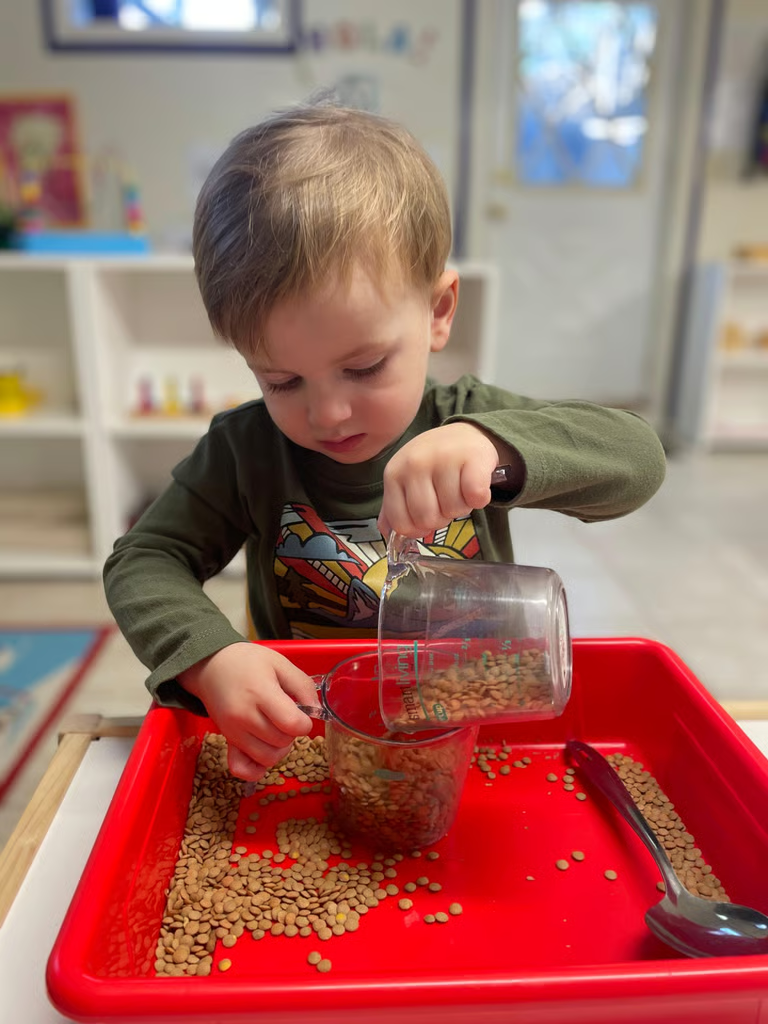
The Montessori method is not simply an alternative teaching style. It is a system designed around how the developing brain actually learns: through hands-on manipulation, self-directed exploration, and sequenced challenge. When a child chooses their own work, completes a multi-step task, and self-corrects without adult intervention, they are building executive function — the brain's capacity for planning, focus, and self-control.
Research consistently shows that children in high-fidelity Montessori programs develop stronger executive function, greater independence, and deeper concentration than peers in conventional settings. At Guaria, we add a critical layer: personalization. Because our program is intentionally small, each child's Montessori path is individually observed and guided. There is no single curriculum pace. There is each child's pace.
Pillar 2: Immersion in Spanish
What it builds: neural flexibility, cognitive reserve, auditory discrimination
We do not teach Spanish so that children can speak Spanish. We use Spanish immersion because of what bilingual exposure does to the developing brain during the critical period for language acquisition.
Between birth and approximately age five, the brain is uniquely capable of absorbing the phonological patterns, grammatical structures, and prosodic rhythms of multiple languages simultaneously. After this window, language learning shifts from implicit acquisition to explicit study — a fundamentally different and less efficient process.
But the benefits of early bilingual exposure extend far beyond language. Research in developmental neuroscience has shown that bilingual children develop enhanced executive function, superior attentional control, and greater cognitive flexibility compared to monolingual peers. The brain of a child managing two language systems is constantly exercising the neural circuits responsible for inhibition, switching, and monitoring — the same circuits that underlie problem-solving, self-regulation, and academic achievement.
This is why we frame Spanish immersion as brain architecture, not communication. The language itself is valuable. But the cognitive infrastructure it builds is the real return.
Pillar 3: Scientific Discovery
What it builds: causal reasoning, hypothesis testing, observational skills
Young children are natural scientists. They observe, test, and revise their understanding of the world constantly. But this instinct, left unguided, remains informal. At Guaria, we structure scientific exploration to develop genuine reasoning skills — the ability to ask a question, design a way to test it, observe what happens, and draw a conclusion.
This is not about teaching "science facts." It is about building the cognitive habit of reasoning from evidence. Research shows that children who engage in structured inquiry-based learning during early childhood develop stronger causal reasoning, better transfer of learning across domains, and a more robust understanding of how the world works.
At Guaria, scientific discovery is woven into the daily environment: water experiments, nature observation, sensory exploration, and guided questioning. Each activity is designed to exercise the brain's capacity for logical thought during the period when that capacity is being wired.
Pillar 4: Music
What it builds: auditory processing, pattern recognition, mathematical thinking
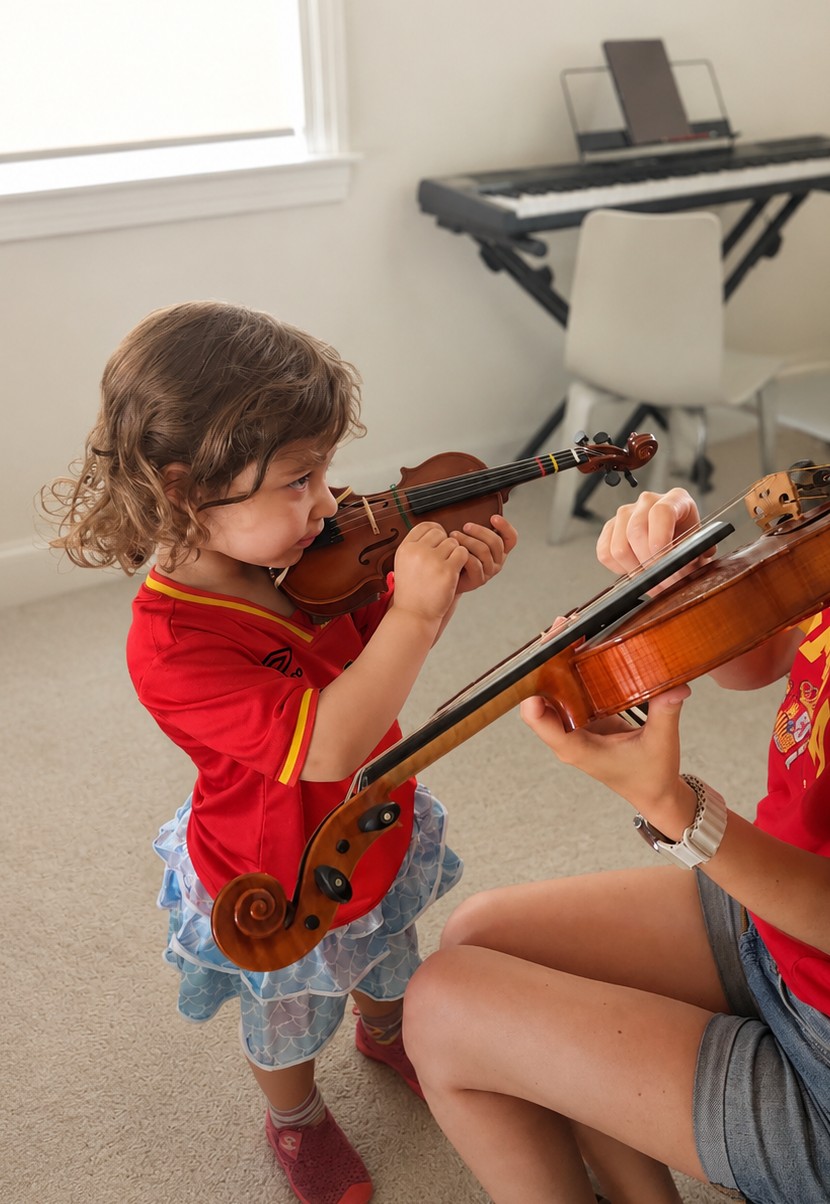
Music at Guaria is not enrichment. It is not a sing-along or background activity. It is genuine instruction on real instruments, led by a music educator with a master's degree from Berklee College of Music.
This distinction matters because the neuroscience of music and brain development is unambiguous: structured musical training during early childhood produces measurable changes in brain structure and function. Children who receive formal music instruction show enhanced auditory processing, superior working memory, stronger mathematical reasoning, and greater neural efficiency in language processing.
The mechanism is straightforward. Music requires the brain to process pitch, rhythm, timing, and pattern simultaneously — engaging auditory, motor, and prefrontal circuits in coordinated activity. When this happens during the critical period, the neural pathways involved become stronger, faster, and more interconnected.
This is why we invest in a professional music educator rather than casual musical activities. The quality and structure of the instruction directly determines the neurological benefit.
The compounding effect
Each of the four pillars is valuable on its own. But the reason we use all four together is that they compound. The executive function built through Montessori work makes a child better at managing two languages. The auditory discrimination developed through music makes a child more sensitive to the phonological patterns of a second language. The reasoning skills built through scientific discovery make a child more capable of the problem-solving embedded in Montessori materials.
This is not theoretical. It is the observable reality of what happens when a child's brain receives structured, multi-domain stimulation during its most formative period. The pillars do not compete for time — they multiply each other's effects.
Why it must be now
The critical periods that make this method possible are not permanent. The brain's extraordinary plasticity during the first four years of life is a biological fact with a biological timeline. The synaptic density peaks, the pruning begins, and the window narrows.
This does not mean that learning stops after age four. Children continue to grow and develop throughout childhood. But the foundational architecture — the neural infrastructure on which all future learning is built — is largely established during these earliest years. What is built well now supports everything that comes after. What is not built now becomes progressively harder to construct.
This is why Guaria exists. Not because daycare is bad, but because these years deserve more. They deserve a program designed for the brain, not just the schedule. A program that treats every day as an opportunity to build something that will last — carefully, joyfully, and with purpose.
A small program by design
None of this works at scale. Personalized Montessori requires knowing each child deeply. Language immersion requires consistent, natural interaction. Scientific discovery requires guided facilitation. Music requires real instruction. All of this requires a small group, a dedicated guide, and the kind of attention that is only possible when a program is intentionally limited in size.
Guaria is small because it has to be. The method demands it. And for the families who choose it, that smallness is not a limitation — it is the reason it works.
Questions? Bring them to your tour.
We love talking about this work — and we'd love to show you what it looks like in practice.